TARGET DECK: MED::I::Medical Physics::02 - Dynamics
Concept of Force
What is Dynamics?
Definition of Dynamics
Dynamics studies the effect of forces on the motion of bodies. It is based on the principles of dynamics, codified by Newton towards the end of the 1600s.
- Central concept is force, already known before Galileo
- Dynamics introduces new concepts: mass, momentum, and strength
- It was believed that force was provoked by motion, but Galileo overturned this paradigm, introducing the idea that it is the force that causes a change in the state of motion
- The Aristotelian conception of motion assumed that in the absence of forces no motion should occur — this is contradicted by the principle of inertia
What did Galileo overturn regarding force and motion?
Galileo overturned the Aristotelian idea that force is provoked by motion, establishing instead that force causes a change in the state of motion.
Definition of Force
Definition
We call force any cause that can change the speed of a body.
- Speed can vary both in magnitude and in direction
- A ball bouncing off a wall changes the direction of its velocity → it experiences a force
- A body following a curved trajectory varies its velocity in direction, not necessarily in magnitude
- Forces can also cause deformations
Anki cloze
Force is defined as any cause that can change the {1:speed (magnitude or direction)} of a body.
Vector Nature of Force
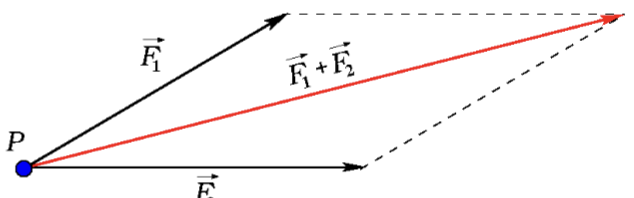
- Two forces and applied at the same point are equivalent to a single force obtained by their vector sum
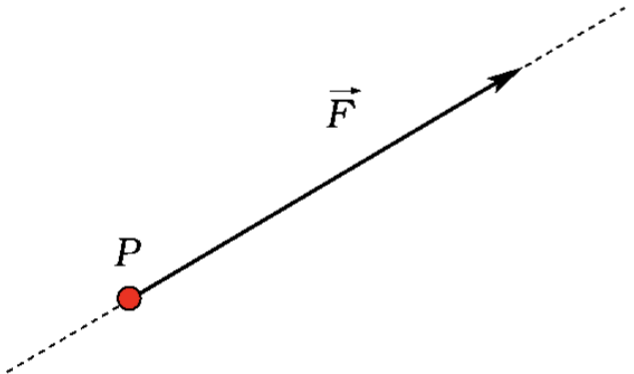
- To completely specify a force, you must also know its point of application
How to Measure Forces
Dynamometer (elastic force):
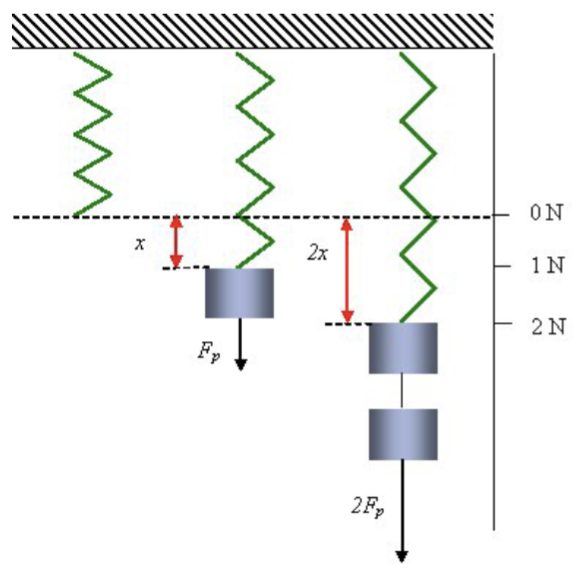
- Elongation is proportional to force:
- Weight:
What instrument measures force using elastic elongation?
A dynamometer. Its elongation is proportional to the applied force: .
First Principle
First Principle (Principle of Inertia)
First Principle
In the absence of forces, a body keeps its speed unchanged — neither in direction/sense (→ motion is rectilinear) nor in magnitude (→ motion is uniform). In the absence of forces, a body moves with straight and uniform motion.
- Reference systems that are inertial (differing at most by a constant velocity ) describe the same forces
- Special case: → in the absence of force, a body at rest remains at rest
Anki cloze
According to the first principle of dynamics, in the absence of forces, a body moves with {1:straight and uniform} motion.
Inertial Mass
Inertial vs. Gravitational Mass
In the interaction between two isolated material points, the ratio between velocity variations is inversely proportional to the ratio of their respective masses:
| Property | Inertial Mass | Gravitational Mass |
|---|---|---|
| Nature | Dynamic — resistance to change in motion | Parameter associated with gravitational pull (“gravitational charge”) |
| Numerical value | Coincides with gravitational mass | Coincides with inertial mass |
| Analogy | — | Unlike electrostatics: inertial mass ≠ electrostatic charge |
What is the difference between inertial mass and gravitational mass?
Inertial mass is a dynamic property (resistance to change in motion).
Gravitational mass is the gravitational “charge” of a body.Numerically and dimensionally they coincide — unlike in electrostatics, where inertial mass ≠ electrostatic charge.
Second Principle
Second Principle (Newton’s Second Law)
Second Principle
If a force acts on a body, the body gains an acceleration proportional to :
- The constant is the inertial mass of the body — related to its resistance to varying its speed
- SI unit of mass: kilogram (kg)
Anki cloze
The second principle of dynamics states that {1:}, where is the inertial mass.
The Newton (Unit)
1 Newton
1 Newton is the force that gives a body of 1 kg an acceleration of 1 m/s².
Applications of :
- constant → uniformly accelerated motion (e.g. )
- Elastic spring → acceleration proportional to elongation, opposite direction → harmonic motion
- Gravitational force:
What type of motion results from a constant force acting on a body?
Uniformly accelerated motion (e.g. free fall under gravity ).
What type of motion results from an elastic spring force ?
Harmonic motion — acceleration is proportional to elongation but directed in the opposite direction.
Ratio Between Weight and Mass
For different objects with different masses, the ratio between weight force and mass remains constant:
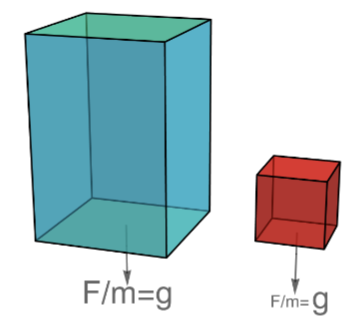
Anki cloze
The gravitational acceleration at Earth’s surface is {1:}, derived from .
Frictions and Constraints
Kinetic friction force:
where is the coefficient of (kinetic) friction and is the force perpendicular to the surface.
Fluid friction force:
where is a coefficient depending on the shape of the object and the nature of the medium, and is the speed of the object.
- Smooth constraint: no friction
- Non-smooth constraint: friction present
Terminal Velocity
Terminal Velocity
If there is a fluid friction force and a constant force is applied, the resulting motion is uniform rectilinear at a final (terminal) speed:
If (weight):
Why does a constant force not always produce uniformly accelerated motion?
In the presence of fluid friction , the net force decreases as speed increases, eventually reaching zero → the body reaches a constant terminal velocity .
Quantity of Motion (Momentum)
Momentum Form of the Second Principle
The second principle can be expressed in terms of quantity of motion (momentum) :
If is constant: , thus:
Anki cloze
Momentum is defined as {1:}, and the second principle generalises to {2:}.
Third Principle
Third Principle of Dynamics (Action–Reaction)
Third Principle
If body A exerts a force on body B, then body B exerts a force on A that is equal in magnitude and opposite in direction.
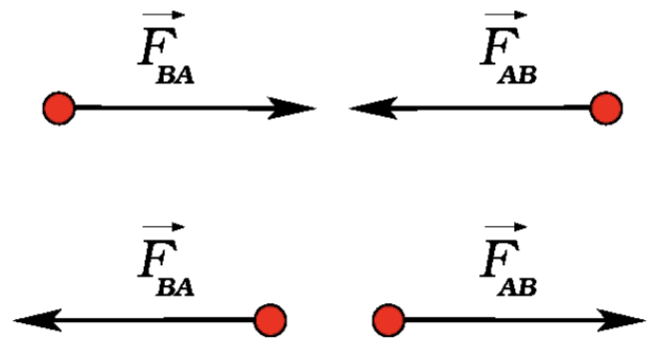
State Newton's Third Law in formula form.
— action and reaction forces are equal in magnitude and opposite in direction.
Action and Reaction: Different Effects
Although the action–reaction pair are equal and opposite, their effects differ because the masses may differ:
Therefore:
Key insight:
The accelerations caused in two interacting bodies are inversely proportional to their masses.
Anki cloze
In an action–reaction pair, the accelerations of the two bodies are {1:inversely proportional} to their {2:masses}.
Conservation of Momentum
For a system of two masses and :
- Momentum of each:
- Total momentum of system :
Conservation Statement (Third Principle — Conservative Form)
The momentum of an isolated system (no external forces) is constant:
Under what condition is the total momentum of a system conserved?
When no external forcesact on the system () — i.e. the system is isolated.
Center of Mass
Definition — Center of Mass
The center of mass (or centroid) of a system of material points is defined as:
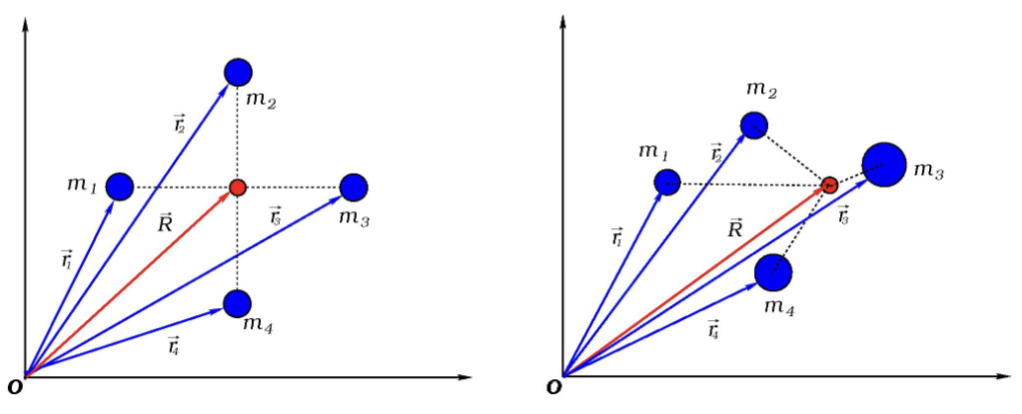
It corresponds to the mass-weighted average position of all material points in the system.
Center of Mass: Velocity
- In an isolated system, the velocity of the center of mass is constant
- The speed of the center of mass equals the total momentum divided by total mass:
Anki cloze
The velocity of the center of mass is given by {1:}, and in an isolated system it is {2:constant}.
TLDR
TLDR — Three Principles of Dynamics
- Dynamics studies the effect of forces on motion; Newton codified its principles in the late 1600s. Galileo established that force causes changes in motion, overturning Aristotle.
- Force is any cause that changes a body’s velocity (magnitude or direction); it is a vector requiring a point of application. Measured with a dynamometer: .
- First Principle (Inertia): In the absence of forces, a body moves in a straight line at constant speed. Inertial reference frames differ at most by a constant velocity.
- Inertial mass resists changes in motion; gravitational mass is the gravitational “charge.” They are numerically equal (unlike electrostatics).
- Second Principle: . 1 N gives 1 kg an acceleration of 1 m/s². Constant force → uniform acceleration; elastic force → harmonic motion; gravitational: .
- Gravitational acceleration: — independent of the body’s mass.
- Kinetic friction: ; fluid friction: → terminal velocity .
- Momentum: ; second principle generalises to . Reduces to when is constant.
- Third Principle (Action–Reaction): . Forces are equal in magnitude, opposite in direction; effects differ because .
- Conservation of momentum: For an isolated system (), total momentum .
- Center of mass: — mass-weighted average position. In an isolated system, .